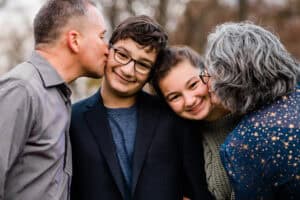
 In early 2018, 10-year-old Nicholas Urzynicok complained of left knee pain while skiing with his family. After weeks of intermittent pain followed by a limp, Nick’s PE teacher suggested he see a doctor. After reviewing an X-ray, the doctor informed Nick and his family that he likely had osteosarcoma and referred them to Johns Hopkins. The following morning, Nick and his family met Dr. Christine Pratilas, Dr. Adam Levin, and Dr. Daniel Rhee. Nicholas was officially diagnosed with osteosarcoma on April 23, 2018, two days after his 11th birthday.
The team at Hopkins moved quickly. Before treatment could begin, however, Nick needed a chest CT and a bone scan as a baseline. It was during this bone scan that an additional osteosarcoma tumor was discovered in Nick’s right tibia. This was exceedingly rare, and changed Nick’s diagnosis to multifocal osteosarcoma, a diagnosis that has a dismal prognosis. The doctors also suspected metastasis in both lungs from his chest CT. During all of this, by his side were his mom, Michelle, and his dad, Frank, and with sister, Anne-Katrin.
Nicholas was tested for a genetic pre-disposition for cancer as his diagnosis was so rare, but did not exhibit any genetic markers.
Harford Day School, where Nicholas was a 5th grader at the time of diagnosis, was very supportive. Nicholas was unable to attend school once treatment started. Harford Day School provided a robot, equipped with an iPad, to allow Nicholas to participate in school and complete 5th grade. He also had home visits from a wonderful teacher who donated her time to helping him keep up with his classmates.
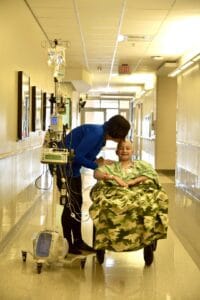 During the summer of 2018, after two cycles of front-line chemotherapy (10 weeks), Nicholas underwent double limb salvage surgery performed by Dr. Levin. Nicholas had the osteosarcoma tumors in both legs resected during one, long surgery and were replaced with titanium endoprosthetics. Nick also had a double knee replacement in order to get good margins. The recovery from this massive surgery was long, intense, painful and caused many complications.
The most life-altering complication was cauda equina syndrome, which, due to swelling at the end of the spinal cord, causes severe numbness and weakness in the lower half of one’s body. This left Nick with a neurogenic bladder and bowel, requiring him to administer an intermittent catheter for nearly a year. He eventually received extensive physical rehabilitation through the Spinal Cord Injury Institute at Kennedy Krieger Institute (KKI).
Now that Nick had two non-weight bearing, immobilized legs and a large, painful incision across one side of his back, his parents could not safely transport Nick to his appointments. Thankfully, through the generosity of Frank’s employer, Analytical Graphics, Inc., the family was provided with a wheelchair-accessible van. This made a huge difference in their ability to get Nick where he needed to be.
Once Nick had healed enough from the double limb salvage surgery, he restarted chemotherapy. He did two more cycles of chemo lasting 10 weeks, followed by his first of two lung surgeries performed by Dr. Rhee. Nick then received a 5-week chemo treatment. After the surgery on the other lung, Nick received one final cycle of chemo. At this point, Nick was declared NED (No Evidence of Disease) and could take time to heal and rehabilitate.
Because of Nick’s multifocal osteosarcoma diagnosis, Dr. Pratilas thought that a unique approach was warranted. She went through considerable effort of obtaining an immunotherapy called Mepact, commonly used in Europe. Nick started Mepact infusions in 2019 and completed the entire 9-month course.
 In the fall of 2019, feeling stronger, Nick began to engage in adaptive sports, such as wheelchair basketball, sled hockey and mono-skiing. The Bennett Blazers are Nick’s adaptive sports team, who train at Kennedy Krieger High School with coaches Gwena and Gerry Hermann.
Two years later, before an evening wheelchair basketball practice, Nick told his mom about a new bump on his head. The prompt MRI unfortunately indicated the bump to be an osteosarcoma recurrence. A PET scan showed that there were also new tumors in Nick’s hip and right lung. He proceeded to complete ten cycles of second-line chemotherapy called Ifosfamide and Etoposide, and have all three of his relapse tumors resected.
Today, Dr. Pratilas, who serves on the CCF Scientific Advisory Board, continues to oversee Nick’s treatment along with Dr. Rhee, who oversees his lung health and Dr. Levin, who oversees his hip and knee surgeries. Due to the complexity of Nick’s diagnosis, he receives scans every 12 weeks.
In Fall 2022, Nick, a Carroll Scholar and high school sophomore in the STEAM program at the John Carroll School in Bel Air, MD, qualified for a clinical trial out of Nationwide Children’s Hospital in Columbus, OH. This meant driving back and forth to Columbus to enroll in the trial and for check-ups every 12 weeks. Nick participated in the study for nine months, when during a routine scan, a new osteosarcoma tumor was detected in his left wrist. This meant dropping out of the study and adding Dr. Sophia Strike, an orthopedic hand surgeon, to Nicholas’ team. Nicholas underwent wrist surgery in September 2023, where the tumor was resected and an allograft was put in its place.
Despite numerous setbacks, Nick began his junior year of high school, found a routine and has attempted to keep things as normal as possible. Nick received his driver’s license in January 2024 and enjoys spending time with his friends. Anne-Katrin is now a freshman at the University of Michigan, studying biomedical engineering, in part inspired by her brother’s journey.
Today, Nick’s wrist has healed, but a February 21, 2024 routine PET scan detected a small spot, which was removed in March. He still faces a fast-growing tumor on his lung.
 The family noted how thankful they are for the care of the team at Hopkins. The family has been involved with the tumor board and the big surgery decisions every step of the way.
Following Nicholas’ motivation, the Urzynicok family remains strong, hopeful, and incredibly resilient. And, it is easy to see how inspired the family is. Nicholas is incredibly calm and works extremely hard to maintain a normal routine, despite the many appointments, treatments, surgeries, and setbacks.
CCF is thrilled to welcome Nicholas and his family to join us at the 8th annual Research Symposium on June 5, 2024.